Cm9 — C minor ninth chord
A minor seventh chord with the ninth added. The ninth is a whole tone above the root.
- 1 = C
- 9 = D
- b3 = Eb
- 5 = G
- b7 = Bb
- Symbol
- Cm9
- Root
- C
- Quality
- Minor ninth
- Family
- extended
- Notes
- C D Eb G Bb
- Degree formula
1 9 b3 5 b7- Semitones from the root
0 2 3 7 10- Distinct pitch classes
- 5
- Interval structure
- Stacked from the root: 2 semitones, 1 semitones, 4 semitones, 3 semitones
- Notation
- Written m9. The chord on the second, third and sixth degrees of a major key when the ninth is wanted.
- Key
- C · C major / A minor key signature
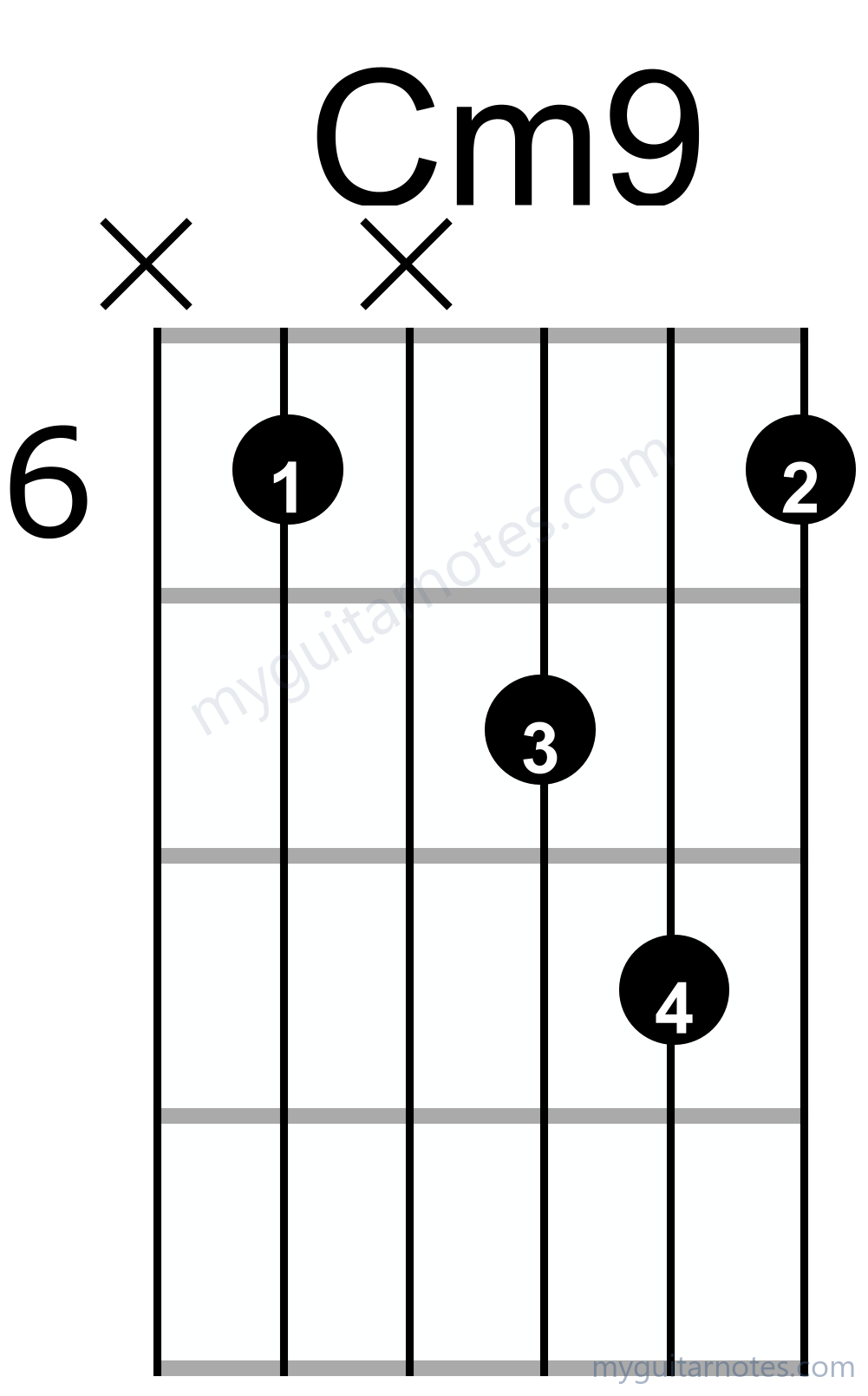
Interval charts
Interval charts the library holds for this chord, each one paired with its fingering chart.
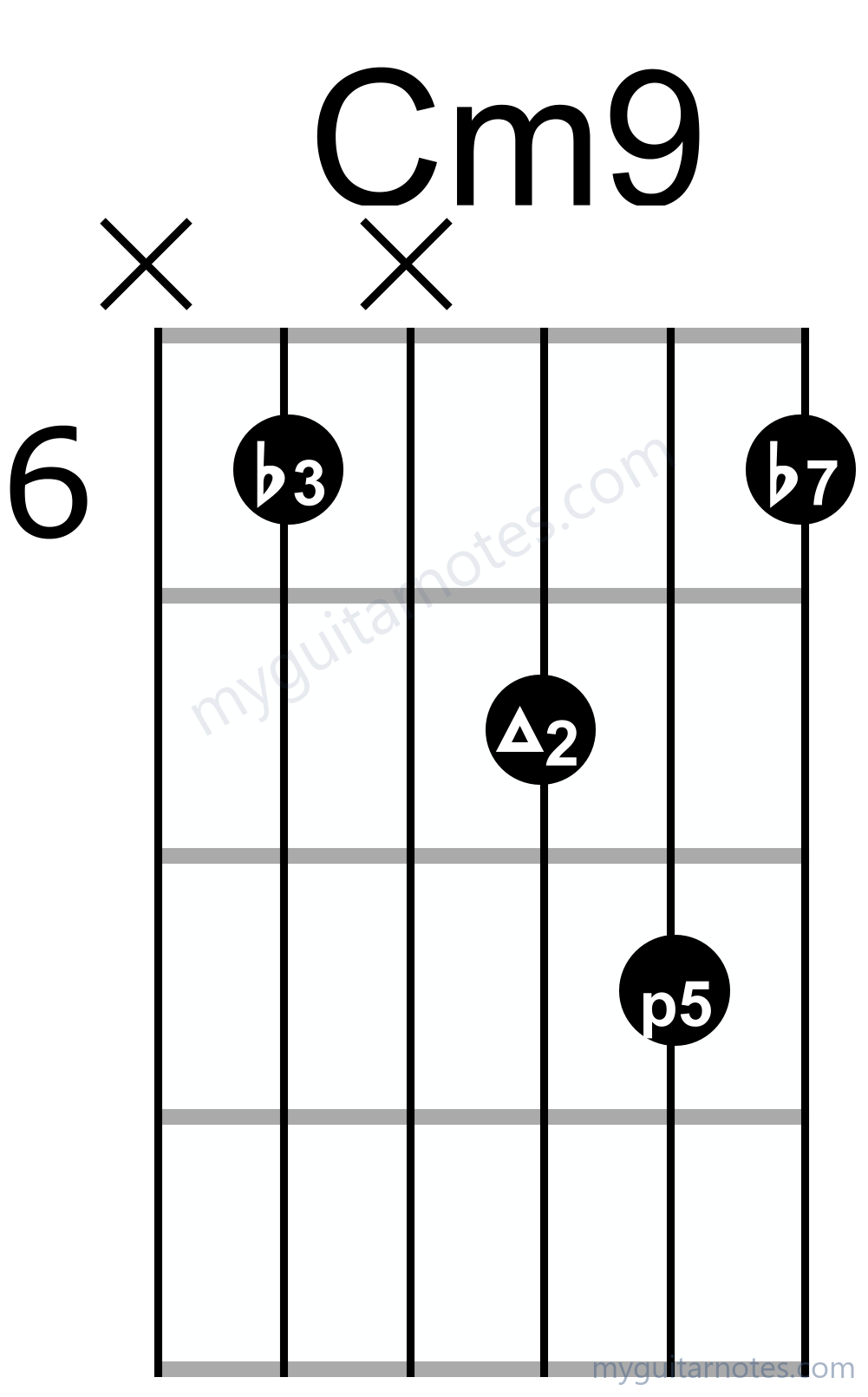
Formula
The chord tones in order from the root, with the interval each one forms above it.
| Degree | Note | Semitones | Interval from the root |
|---|---|---|---|
| 1 | C | 0 | Perfect unison |
| 9 | D | 2 | Major second |
| b3 | Eb | 3 | Minor third |
| 5 | G | 7 | Perfect fifth |
| b7 | Bb | 10 | Minor seventh |
Inversions
An inversion is the same set of notes with a different one in the bass. The last column gives the distance of each note above the bass note, in semitones.
| Inversion | Bass note | Degree in the bass | Notes above the bass | Semitones above the bass |
|---|---|---|---|---|
| root position | C | 1 | C – D – Eb – G – Bb | 0 2 3 7 10 |
| first inversion | D | 9 | D – Eb – G – Bb – C | 0 1 5 8 10 |
| second inversion | Eb | b3 | Eb – G – Bb – C – D | 0 4 7 9 11 |
| third inversion | G | 5 | G – Bb – C – D – Eb | 0 3 5 7 8 |
| fourth inversion | Bb | b7 | Bb – C – D – Eb – G | 0 2 4 5 9 |
Playable voicings
These shapes were found by searching the fretboard of a standard-tuned guitar (E A D G B E) rather than copied from a chord book. The search allows every string to sound or to be muted, rejects any shape with a muted string between two sounding strings, rejects any shape whose fretted notes span more than four frets (a five-fret window), requires every chord tone to be present, and then sorts what remains with root-position shapes first and the most compact, lowest shapes next. The shapes shown are the first six of that ordering; other orderings are possible at the same frets.
| # | Shape (low string first) | Notes | Degrees | Bass | Span (frets) | Sounding strings |
|---|---|---|---|---|---|---|
| 1 | 8-6-8-7-8-6 | C D# A# D G A# | 1 b3 b7 9 5 b7 | C | 2 | 6 |
| 2 | 8-6-8-7-8-8 | C D# A# D G C | 1 b3 b7 9 5 1 | C | 2 | 6 |
| 3 | 8-10-8-8-8-10 | C G A# D# G D | 1 5 b7 b3 5 9 | C | 2 | 6 |
| 4 | 8-5-5-8-8-6 | C D G D# G A# | 1 9 5 b3 5 b7 | C | 3 | 6 |
| 5 | 8-6-5-7-8-6 | C D# G D G A# | 1 b3 5 9 5 b7 | C | 3 | 6 |
| 6 | 8-5-8-8-8-6 | C D A# D# G A# | 1 9 b7 b3 5 b7 | C | 3 | 6 |
Shape numbers run from the lowest string to the highest, so the left-hand number is the sixth string (low E) in standard tuning. Multiple shapes are listed because a chord can be voiced several ways, and because a lower position is not always the better sounding one.
Related chords and scales
- KeyEverything in C
- ScaleC dorian
- ChordCm7
Related
- KeyKey of C
- ScaleC dorian
- ChordCm7 — Minor seventh
- ChordC11 — Dominant eleventh
- ChordC13 — Dominant thirteenth
- ChordC9 — Dominant ninth
- DegreesC — degree map
- Neck mapC — note map