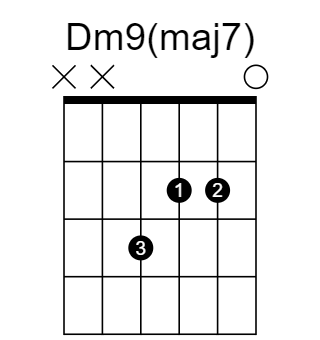
Dm9(maj7) — D minor ninth major seventh chord
A minor major seventh chord with the ninth added. The ninth and the major seventh are a semitone apart, which is what gives the chord its density.
- 1 = D
- b3 = F
- 5 = A
- 7 = C#
- 9 = E
- Symbol
- Dm9(maj7)
- Root
- D
- Quality
- Minor ninth major seventh
- Family
- extended
- Notes
- D F A C# E
- Degree formula
1 b3 5 7 9- Semitones from the root
0 2 3 7 11- Distinct pitch classes
- 5
- Interval structure
- Stacked from the root: 3 semitones, 4 semitones, 4 semitones, 3 semitones
- Notation
- Written m9(maj7). Common on the tonic of a minor key in modern jazz.
- Key
- D · D major / B minor key signature
Formula
The chord tones in order from the root, with the interval each one forms above it.
| Degree | Note | Semitones | Interval from the root |
|---|---|---|---|
| 1 | D | 0 | Perfect unison |
| b3 | F | 3 | Minor third |
| 5 | A | 7 | Perfect fifth |
| 7 | C# | 11 | Major seventh |
| 9 | E | 2 | Major second |
Inversions
An inversion is the same set of notes with a different one in the bass. The last column gives the distance of each note above the bass note, in semitones.
| Inversion | Bass note | Degree in the bass | Notes above the bass | Semitones above the bass |
|---|---|---|---|---|
| root position | D | 1 | D – F – A – C# – E | 0 3 7 11 2 |
| first inversion | F | b3 | F – A – C# – E – D | 0 4 8 11 9 |
| second inversion | A | 5 | A – C# – E – D – F | 0 4 7 5 8 |
| third inversion | C# | 7 | C# – E – D – F – A | 0 3 1 4 8 |
| fourth inversion | E | 9 | E – D – F – A – C# | 0 10 1 5 9 |
Playable voicings
These shapes were found by searching the fretboard of a standard-tuned guitar (E A D G B E) rather than copied from a chord book. The search allows every string to sound or to be muted, rejects any shape with a muted string between two sounding strings, rejects any shape whose fretted notes span more than four frets (a five-fret window), requires every chord tone to be present, and then sorts what remains with root-position shapes first and the most compact, lowest shapes next. The shapes shown are the first six of that ordering; other orderings are possible at the same frets.
| # | Shape (low string first) | Notes | Degrees | Bass | Span (frets) | Sounding strings |
|---|---|---|---|---|---|---|
| 1 | 10-12-11-10-10-12 | D A C# F A E | 1 5 7 b3 5 9 | D | 2 | 6 |
| 2 | 10-7-7-10-10-9 | D E A F A C# | 1 9 5 b3 5 7 | D | 3 | 6 |
| 3 | 10-8-7-9-10-9 | D F A E A C# | 1 b3 5 9 5 7 | D | 3 | 6 |
| 4 | 10-8-11-9-10-9 | D F C# E A C# | 1 b3 7 9 5 7 | D | 3 | 6 |
| 5 | 10-8-11-9-10-10 | D F C# E A D | 1 b3 7 9 5 1 | D | 3 | 6 |
| 6 | 10-7-7-6-6-9 | D E A C# F C# | 1 9 5 7 b3 7 | D | 4 | 6 |
Shape numbers run from the lowest string to the highest, so the left-hand number is the sixth string (low E) in standard tuning. Multiple shapes are listed because a chord can be voiced several ways, and because a lower position is not always the better sounding one.
Related chords and scales
- KeyEverything in D
- ScaleD melodic minor (ascending)
- ChordDm9
- ChordDm
- ChordDm7
Related
- KeyKey of D
- ScaleD melodic minor (ascending)
- ChordDm9 — Minor ninth
- ChordDm — Minor
- ChordDm7 — Minor seventh
- ChordD11 — Dominant eleventh
- ChordD13 — Dominant thirteenth
- ChordD9 — Dominant ninth